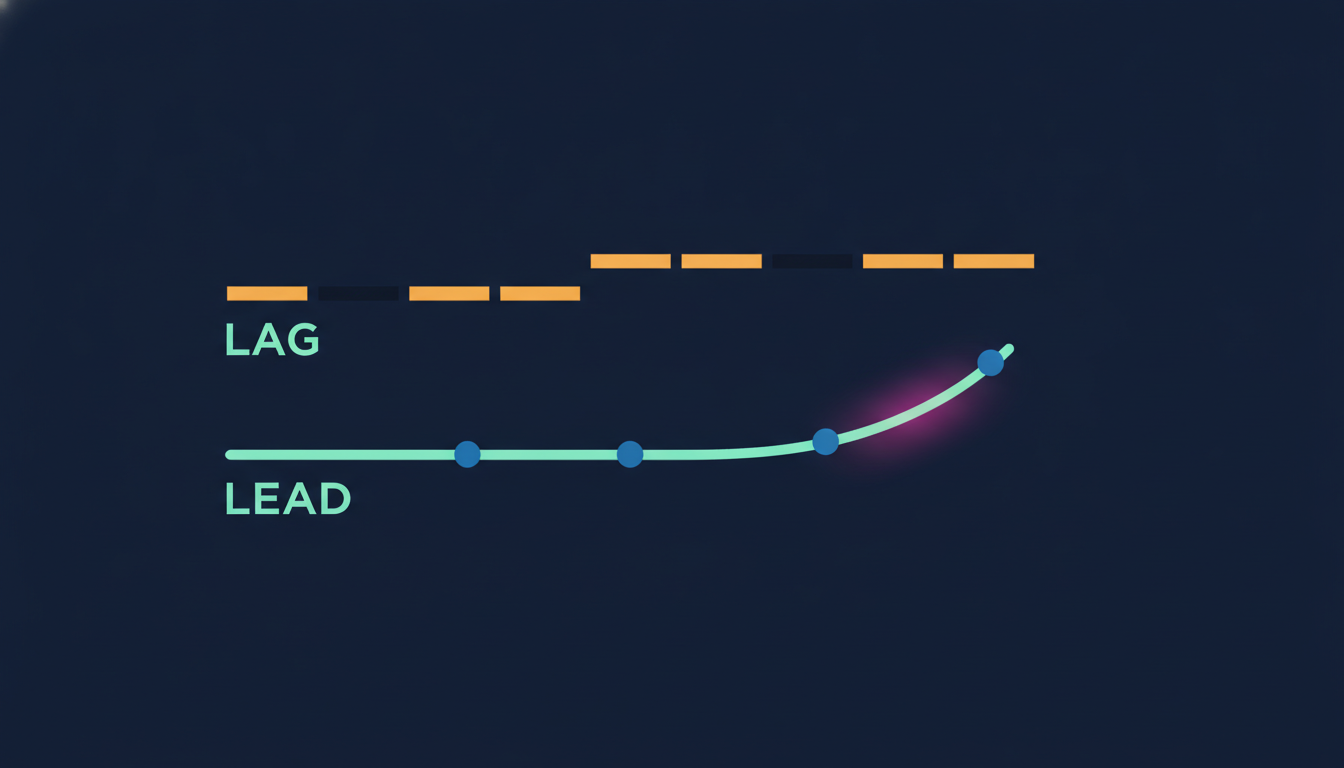
Are your numbers current?
Not "do you have numbers." Every company has numbers. I am asking whether the figure you looked at this morning describes this morning, or describes a month that has already ended.
For most companies I sit across the table from, the honest answer is that the numbers are three weeks old.
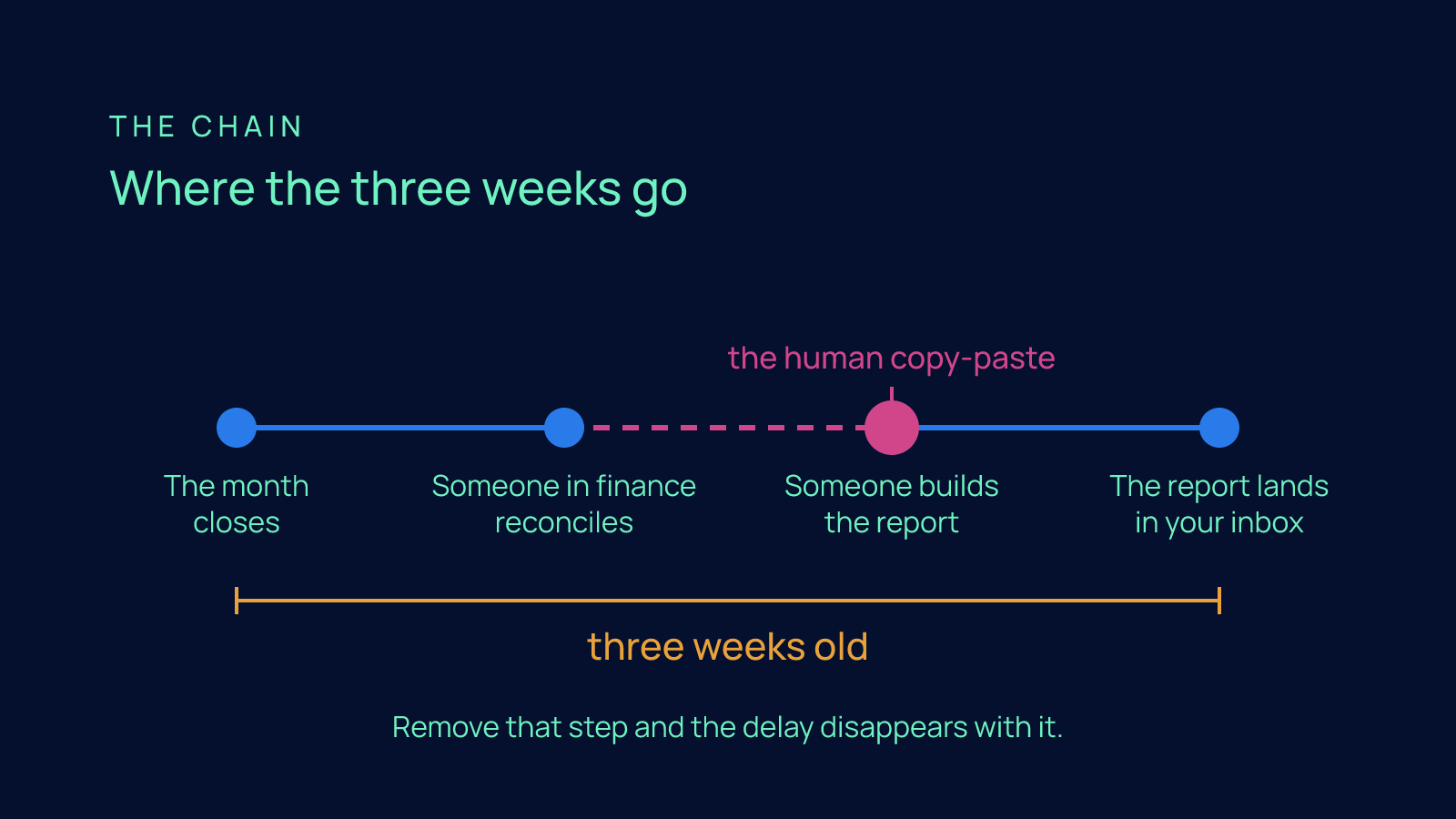
Here is the chain that makes it so. The month closes. Someone in finance reconciles, which is the plain word for checking that the bank, the ledger, the invoices and the card statements all agree with each other. Then someone builds the report, usually in a spreadsheet, usually by hand, usually by copying figures from one system and pasting them into another. Then the report lands in your inbox. By the time it does, the month it describes is history. You read it, you nod, you make a decision, and the decision is about a world that no longer exists.
That is how most companies run: every decision made in the rear-view mirror, with a delay built into the process and nobody questioning it, because that is how it has always been done.
The Friday nobody puts on the P and L
There is a second cost hiding in that chain, and it is quieter than the delay.
Someone loses a Friday every month stitching the picture together by hand. Pulling the export. Fixing the columns. Matching an invoice to the client it belongs to, because the accounting system knows the client's legal name and the CRM (the system where sales tracks its deals and contacts) knows the nickname. Chasing the one card charge nobody can explain. Rebuilding the chart because the template broke again.
That Friday never shows up on the profit and loss statement. It is not a line item. It is a person, often a good one, spending a day a month on work that produces no new information. It only reproduces information that already existed somewhere else, in a format somebody else can read.
If you asked that person what they would do with that Friday back, they would not say "nothing." They would say the thing they have been meaning to get to for a quarter.
Kaplan and Norton drew the line that matters
Stale books force you to manage on lag; fresh books let you manage on lead.
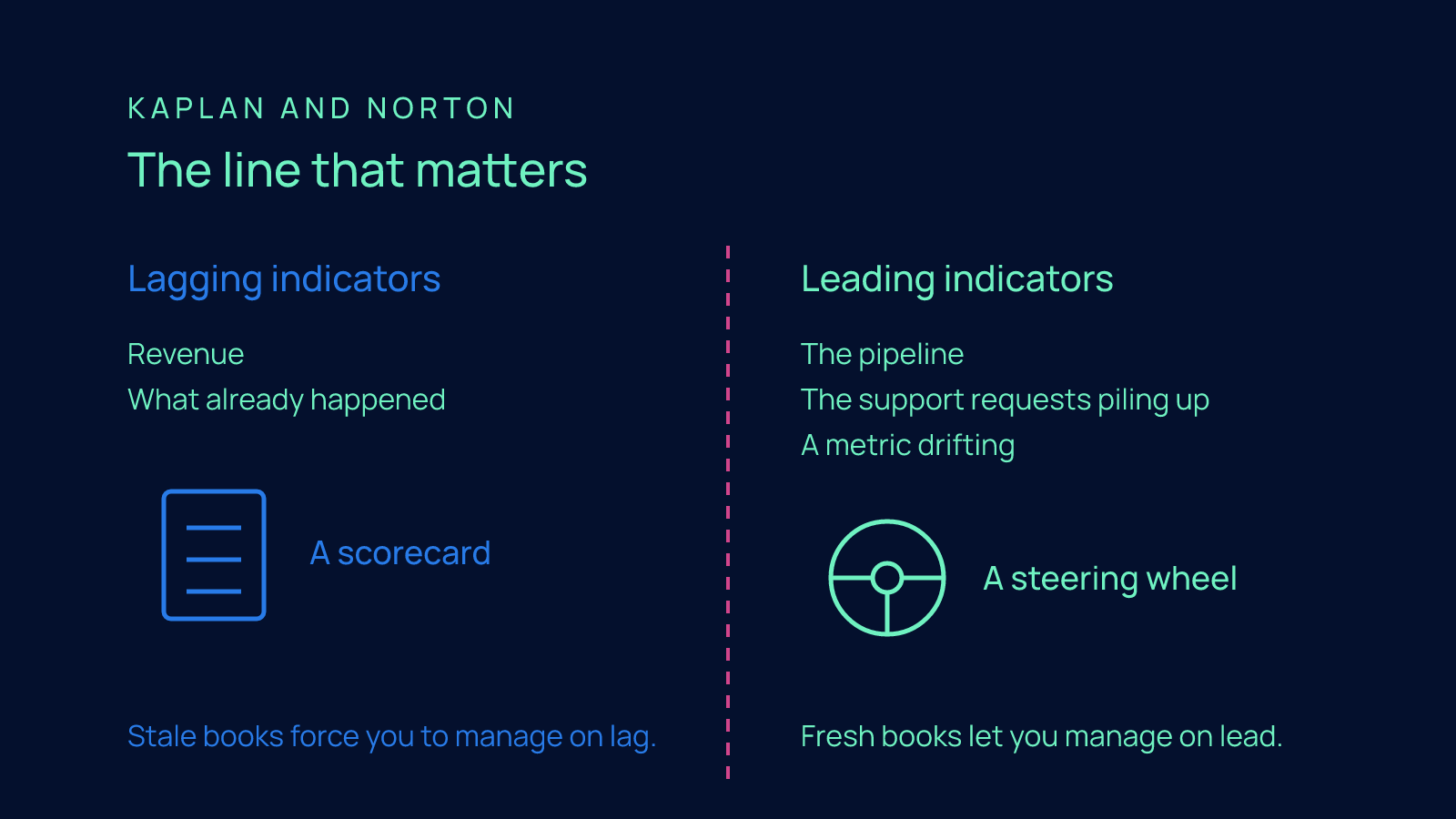
Robert Kaplan and David Norton, the researchers behind the balanced scorecard (a framework for measuring a company on more than its financial results), drew a line that every founder should have taped to the wall.
On one side are lagging indicators. Revenue is the obvious one. A lagging indicator tells you what already happened. It is a result. By definition it arrives after the thing it measures, and there is nothing you can do to change it, because it is done.
On the other side are leading indicators. These tell you what is about to happen. The pipeline (the deals in progress) filling up or thinning out. The support requests piling up faster than last month. A metric drifting a little in the wrong direction, week after week, before it turns into a number you would notice on a quarterly report.
Leading indicators are where management actually happens. A lagging indicator is a scorecard. A leading indicator is a steering wheel.
Here is the part most companies miss. You can only watch the leading indicators if the data flows continuously. A quarterly report cannot show a trend forming. A monthly report that arrives three weeks late cannot either. A trend is a shape that appears over time, and you need to see the points as they land, not a single point long after the fact. A live number can show a trend forming. A stale number cannot.
Stale books force you to manage on lag. Fresh books let you manage on lead.
The problem is not the report
The fix is not a better report, it is removing the human copy-paste between the accounting system and the decisions.
When founders feel the pain of stale numbers, the instinct is to ask for a better report. A cleaner dashboard. A new template. Someone whose job is to produce the report faster.
That is the wrong fix, and I will say it plainly: a better report does not solve a delay. It polishes the thing that arrives late.
The delay lives in one specific place, and it is not the accounting system and it is not the report. It is the human copy-paste between the two. The step where a person pulls numbers out of one system, matches them up by eye, and pastes them into another so a decision can be made.
That step is where the three weeks go. It is where the Friday goes. And it is the step nobody designed on purpose. It accumulated, because the accounting system and the system where decisions get made were never connected, so a person became the connection.
Remove that step and the delay disappears with it. That is the fix. Not a faster person. No person in the middle at all.
How the books sync in our own Company OS
I am not describing a theory. I am describing how Edge8 runs today, inside our own Company OS, which is the plain name for the one system our company actually operates on: the deals, the people, the goals, the tasks and, as of this episode, the books.
In 8 Edges the books sync from the accounting system on a schedule. That is the whole mechanism. The accounting system remains the accounting system. Nobody is asked to switch tools or type anything in twice. On a schedule, the invoices and the figures flow from where the accountant keeps them into the same database where everything else about the company already lives.
Nobody copies numbers. Nobody exports a file. Nobody spends Friday reconciling. The invoice list in our Company OS is the invoice list from the accounting system, as of the last sync, not as of the last time someone remembered to update it.
And the metrics page, the page we look at when we want to know how the company is doing, is this week. Not three weeks old. Not waiting on month end. This week.
That changes which questions you can ask. When the number is current, you can ask "what is happening," not just "what happened."
One home, so an invoice knows where it came from
The sync is the mechanism. The one-database point is the reason the mechanism matters.
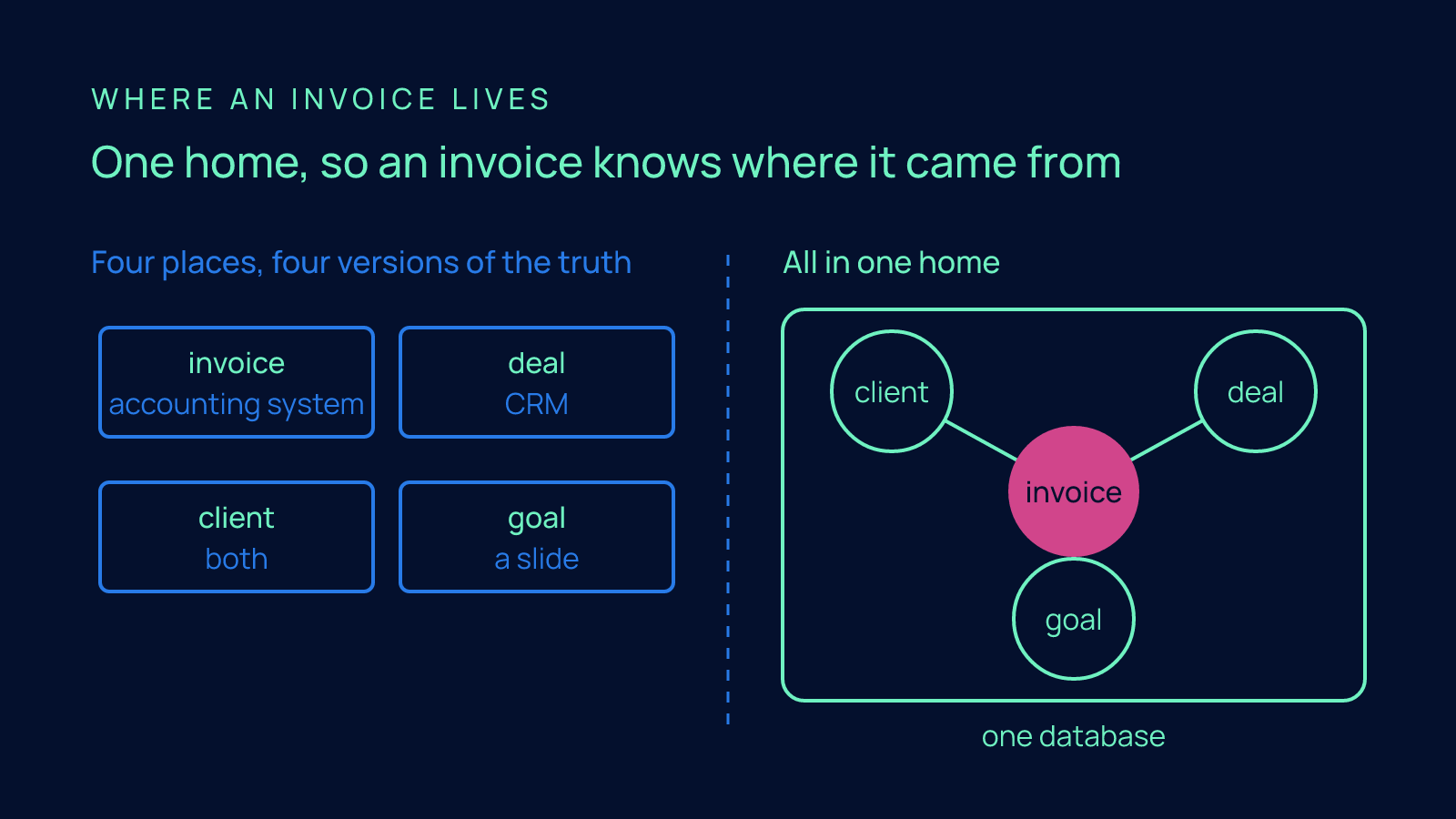
In most companies, an invoice lives in the accounting system and nowhere else. The deal it came from lives in the CRM. The client it belongs to lives in both, under slightly different names. The goal it feeds, the revenue target for the quarter, lives in a slide. Four places, four versions of the truth, and a person doing the matching in their head or in a spreadsheet.
In our Company OS, every invoice lands in the same database as the deals, the people and the goals. All in one home. So an invoice is not just a line with an amount and a date. It is attached to the client it belongs to, the deal it came from and the goal it feeds, because they all live in the same place and the connection is a fact in the system, not a guess in someone's head.
That is what makes the leading indicators visible. When an invoice is attached to its deal, you can see the pipeline turning into revenue as it happens, not as a reconciled total weeks later. When it is attached to its goal, the goal updates itself. When it is attached to its client, you can see which clients are growing and which are quietly shrinking before the quarterly number tells you.
None of that is possible when the books live on their own island. All of it is ordinary when they live at home with everything else.
What the AI did, and what we still decide
The AI pulled, matched and filed every number; the people decide what the numbers mean and what to do about them.
I hold every AI claim to the same two questions, and this episode is no exception. What did the AI just do? What does the person still decide?
What the AI did: it pulled the numbers from the accounting system on a schedule. It matched each one to the right client, the right deal and the right goal. It filed them where they belong, in the one database, so the invoice list and the metrics page are current without anyone touching them.
What the people still decide: what the numbers mean, and what to do about them.
The AI does not tell us that a client is at risk. It puts the current invoices next to the current deal so a person can see the pattern and make the call. It does not decide whether a drifting metric is a problem or noise. It makes the drift visible this week instead of next quarter, so a person can judge. The interpretation is ours. The decision is ours. The copy-paste is gone.
That is the right split. Machines are good at pulling, matching and filing, and they do it the same way every time, without losing a Friday. People are good at judgment. Put each where it belongs.
The scramble did not get faster. It disappeared.
Here is the outcome I care about, and it is the one I would put in front of any founder who thinks this is a finance problem.
The month-end scramble did not get faster. It disappeared.
There is no close to wait for, because the books are always as current as the last sync. There is no report to build, because the metrics page is the report, and it is already there. There is no Friday to lose, because the person who used to spend it reconciling now spends it on something that moves the company.
Numbers you can trust on the day you need them. That is what streamlined operations actually means. Not a smaller finance function, not a cheaper tool, but a company where the gap between what happened and what you know about it has closed to the width of a scheduled sync.
Where this sits in the season
This is Day 22 of the 30-day 8 Edges season, and the second of the four operations fixes inside the week that Day 20 opened, when I argued that operations should stay small as the company grows instead of growing a team to chase requests. Day 21 took the busywork out of approvals. Day 22 takes finance ops, the books, and makes the data-first case for the Operations office: the numbers cannot lead if they arrive late.
Day 23 goes looking for the one constraint behind everything that feels urgent. If you have ever had a week where every fire seemed unrelated and then found they all had the same cause, that one is for you.
Your next step
Watch the Day 22 film. It walks through the scheduled sync, the invoice list and the metrics page as they run in Edge8's own Company OS, so you can see what current books look like rather than take my word for it.
Then reply. Tell me how old your numbers are on the day you make your biggest decisions. If the honest answer is three weeks, I want to show you the sync live and talk about what it would take to close that gap in your company.
FAQ
How do I run my company on current financial numbers instead of books that are three weeks old by the time the month-end report lands?
Stop asking for a better report and remove the step that creates the delay: the human copy-paste between the accounting system and the place decisions get made. Have the books sync from the accounting system on a schedule into the same database where your deals, people and goals already live, so the invoice list and the metrics page are current without anyone touching them. That is how Edge8 runs its own Company OS today, and the metrics page there shows this week, not a month that is three weeks gone. When the number is current you can ask what is happening, not just what happened.
Why are my financial reports always weeks late by the time I read them?
Because of the chain most companies never question: the month closes, someone in finance reconciles the bank, ledger, invoices and card statements, someone builds the report by hand in a spreadsheet, and then it lands in your inbox. For most companies that chain means the numbers you see are three weeks old, and the month they describe is already history. The delay does not live in the accounting system or in the report itself, it lives in the manual step between the two, where a person pulls figures out of one system and pastes them into another.
What is the difference between lagging and leading indicators for a founder?
Robert Kaplan and David Norton, the researchers behind the balanced scorecard, drew the line. A lagging indicator like revenue tells you what already happened and cannot be changed; a leading indicator like the pipeline filling up or support requests piling up tells you what is about to happen. The catch is that leading indicators are only visible when data flows continuously, because a monthly report that arrives three weeks late cannot show a trend forming while a live number can. Stale books force you to manage on lag, fresh books let you manage on lead.
How much time does month-end reconciliation really cost my team?
In most companies it costs a good person a day a month, a Friday spent pulling exports, fixing columns, matching invoices to clients whose names differ between the accounting system and the CRM, and chasing the one card charge nobody can explain. That day never shows up on the profit and loss statement because it is not a line item, and it produces no new information, only a re-copy of information that already existed somewhere else. The matching is needed because an invoice, its deal, its client and the goal it feeds typically sit in four places with four versions of the truth.
What should AI handle in my finance operations and what should I still decide myself?
Hold every AI claim to two questions: what did the AI just do, and what does the person still decide. In Edge8's own Company OS the AI pulls the numbers from the accounting system on a schedule, matches each one to the right client, deal and goal, and files them in one database so the invoice list and metrics page stay current. The people still decide what the numbers mean and what to do about them: the AI does not declare a client at risk, it puts the current invoices next to the current deal so a person can see the pattern this week instead of next quarter.