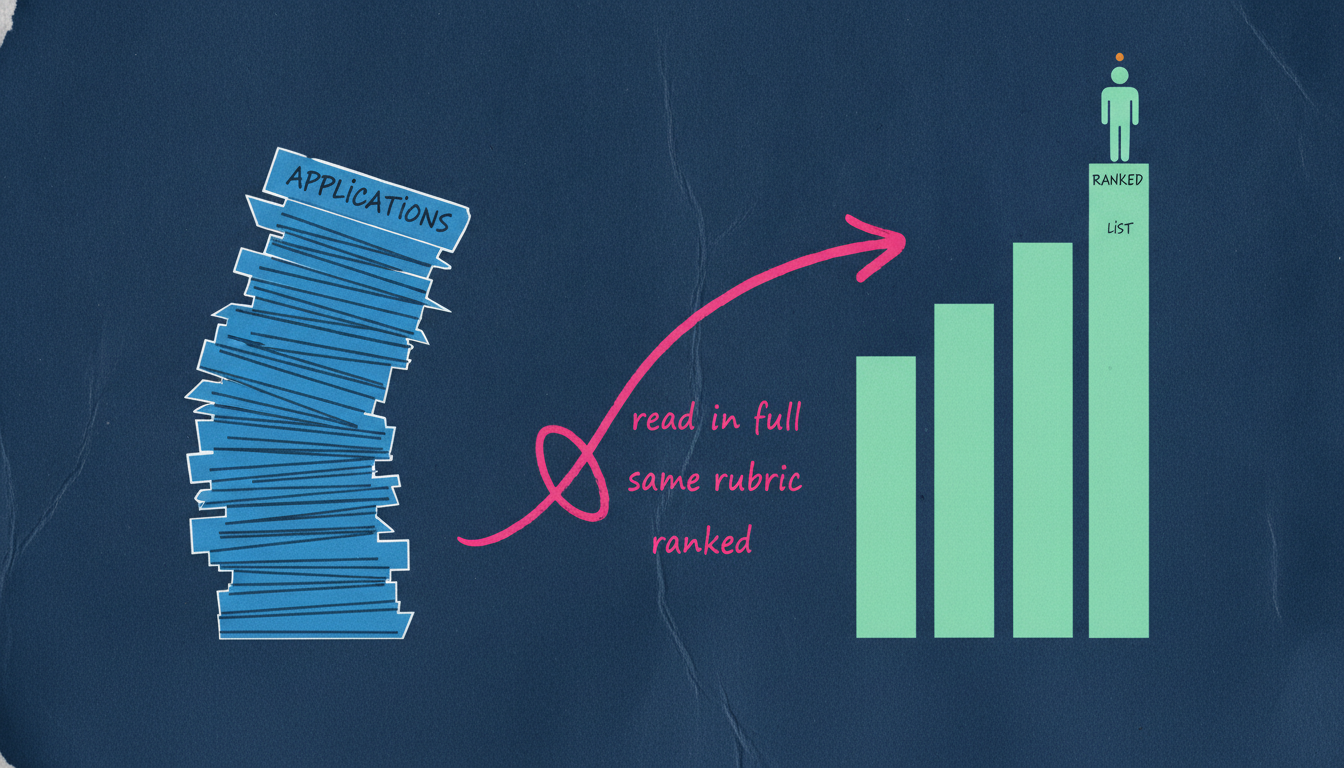
Post one good role and the applications flood in. We posted ours, across the roles Edge8 has open, and they did. Not a stack you clear before lunch. A pile that keeps growing while you are reading it.
If you have hired anyone in the last few years you know the feeling. The job post was the easy part. The pile is where hiring actually goes wrong, and it goes wrong in one of two ways.
Skim or stall
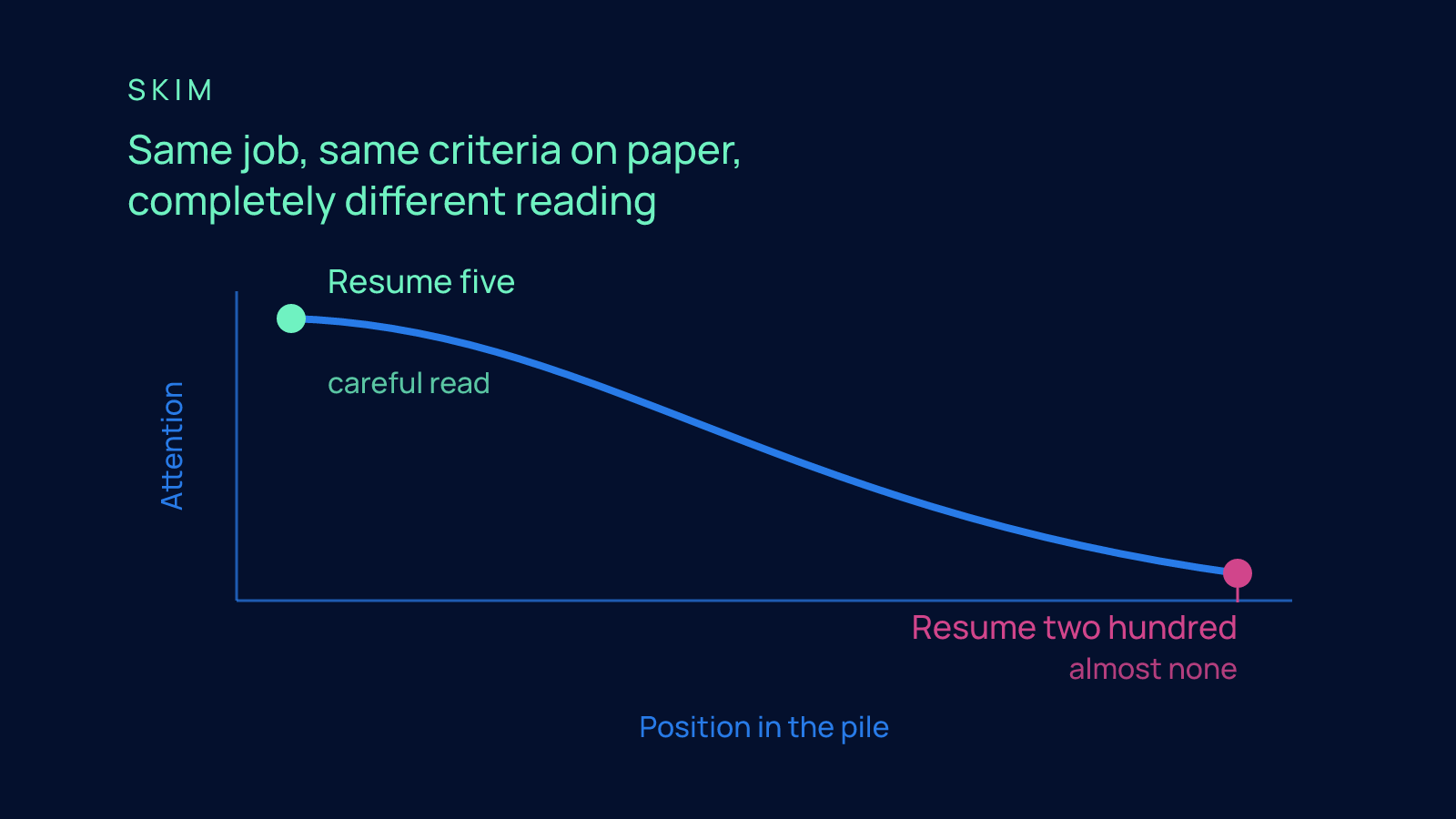
The first is skim. A tired human sits down with the pile and starts reading. Resume five gets a careful read, because the reader is fresh and curious. Resume two hundred gets whatever attention is left at the end of a long afternoon, which is almost none, and that applicant has no idea they were judged by a reader who had already checked out. Same job, same criteria on paper, completely different reading depending on where you landed in the stack. That is not a process. That is luck of the draw.
The second is stall. The pile sits because nobody has a free afternoon, let alone a free week. Days pass. The best person in the pile, who by definition has other options, takes another offer. You never reach their application. You did not reject them. You just never saw them.
Either way the best candidate in the pile may never be seen. That is the real cost, and it is invisible, because you cannot measure the hire you did not make.
This has been known for decades
Schmidt and Hunter reviewed the studies and found unstructured resume review and gut-feel screening among the worst predictors of how someone will actually perform.
None of this is a new discovery. Schmidt and Hunter spent decades reviewing the research on how companies select people, and their review found unstructured resume review and gut-feel screening among the worst predictors of how someone will actually perform on the job. Reading a resume and deciding how you feel about it is, by the evidence, close to the bottom of the list of ways to choose a person.
What wins is structure: the same criteria, applied to every candidate, every time. Decide what the role actually requires before you read a single application, write it down, and hold every applicant to that list. If you cannot write that list down, you are not ready to open the role, because whatever you read into the pile will be whatever you happened to feel that afternoon. I am not going to hedge this. Gut feel on a resume is a bad way to hire. Structure is a better one.
So why does almost every company I talk to still hire by skim?
The knowledge was never the problem
The problem was never that companies did not know this; it is that no human can hold structure for three hundred repetitions, and software can.
Founders assume that if they knew better, they would do better. They do know better. Most CEOs and CTOs I sit across from could tell you that a consistent rubric beats a vibe. The problem was never knowledge.
The problem is repetitions. Structure is easy to hold for a handful of candidates. It is possible for a couple of dozen. No human alive can hold the same rubric, with the same care, through three hundred repetitions on a pile that keeps growing. Somewhere in the middle your criteria have quietly started to drift. Further down you are pattern-matching on company names and job titles, and the applicant who did the job well at a company you have never heard of is the one you lose. This is not a character flaw. It is what attention does under load.
Software does not get tired on application two hundred. Software does not have a long afternoon. The thing the research says works, structure held perfectly through every repetition, is the exact thing a human cannot do and a machine can.
That is the whole case. Here is what it looks like running on a real pile.
Inside the applications board
Day 15 of the 30-day 8 Edges season is the first episode set in the talent office, after Day 14 closed revenue. Back on Day 5 I showed you the resume-screen rubric as one of the frameworks baked into Edge8's Company OS, the operating system our company runs on day to day, and it is where this screening runs. A rubric, in plain language, is a fixed scoring sheet: the criteria for the role, written down once, applied the same way to everyone. Day 15 is that rubric doing the work on applications that actually came in. Part of the pile has been scored so far, and the rest goes through the same way.
Here is the walk.
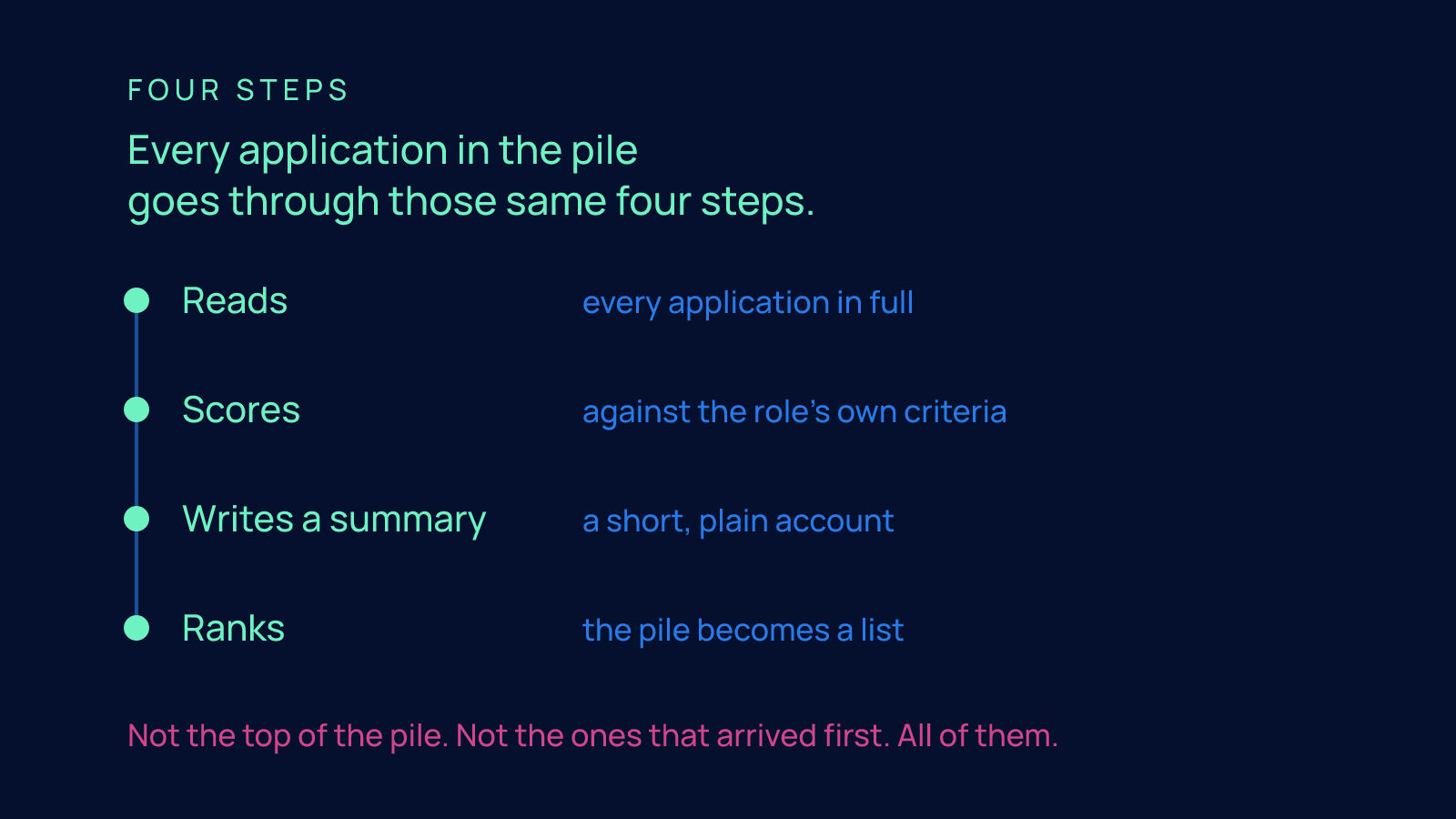
An application arrives on the board. It is not skimmed. The AI reads it in full, every line, against the job description for that specific role. Not a generic screen for "good candidate." The actual criteria we wrote when we opened the role.
It scores the application against those criteria with the same rubric it used for the one before and will use for the one after. No drift. No fatigue. The last application scored gets exactly the same read as the first.
It writes a summary: a short, plain account of what this person brings against what the role needs, so the recruiter does not have to reconstruct the application from scratch to understand why it landed where it did.
Then it ranks. The pile becomes a list, ordered by how each application scored against the role, with the reasoning sitting next to each name.
Every application in the pile goes through those same four steps. Not the top of the pile. Not the ones that arrived first. All of them.
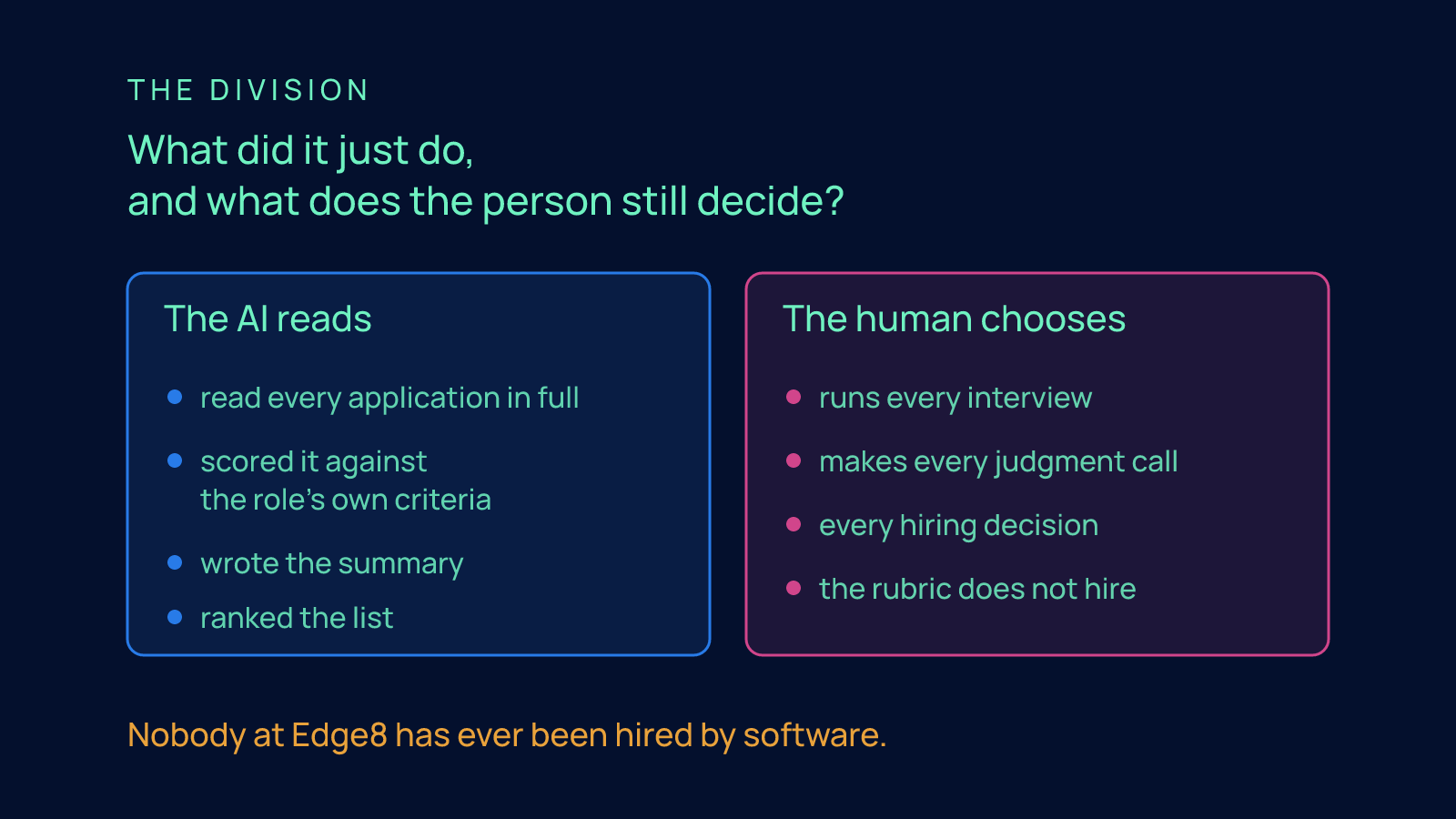
That is what the AI just did: read every application in full, scored it against the role's own criteria, wrote the summary, ranked the list.
The AI reads. The human chooses.
The AI does the reading, the human does the choosing, and nobody at Edge8 has ever been hired by software.
What the person still decides: everything that matters.
Our recruiter runs every interview. She makes every judgment call about who moves forward and who does not. She decides what the summary missed, where the score looks wrong, which candidate further down the list is worth a conversation anyway because of something only a human would notice. Every hiring decision, every single one, is hers and the team's. The rubric does not hire. The ranking does not hire.
Nobody at Edge8 has ever been hired by software. I want to be exact about that line, because the fear I hear most from founders is the opposite picture: a machine quietly rejecting good people with no human anywhere in the loop. That is not what this is. The machine reads so that a human can see everyone. The division is clean, and I would not run it any other way.
That is also the test I would put to any tool a founder shows me. What did it just do, and what does the person still decide? If the honest answer to the second question is "nothing," walk away.
A day at the top of the list
Here is what changed in practice, and it is the part founders underrate.
Before, a recruiter's day started at the bottom of a pile. The first hours went to reading, and the quality of that reading dropped as the hours went on. The interviews, the part of the job that actually requires a skilled person, got squeezed into whatever time was left.
Now her day starts with a ranked list and a summary beside every name. She spends the morning at the top of it, in conversations with the people most likely to be the hire, making the calls only she can make. The reading is already done, and it was done the same way for the applicant at the bottom as for the one at the top. Her judgment is spent where judgment pays, not on the resume that happened to land in front of her late in the day.
And the pile does not sit. Stall was the second failure, and a ranked list on the first morning is the answer to it: the person most likely to be the hire gets a conversation before another offer lands, instead of waiting for a free week that never comes.
That is the swap. Not a human replaced by software. A human moved from the part of the job a machine does better to the part only she can do.
Every one of three hundred, read fairly
When I say three hundred I mean it the way you would say it over coffee: a big pile, more than any one person reads well. The exact count is not the point. The point is that every application in it was read in full, held to the same criteria, and given the same attention whether it arrived first or last. That is fair to the applicant, who gets the same read no matter when they applied. It is fair to the recruiter, who no longer carries the pile alone. And it is fair to the company, which finally sees who actually applied. That is what fair looks like in hiring, and it is what the selection research has been telling us to do for decades. We just needed something that could hold the structure through all the repetitions.
If you are a founder with a pile right now, the question to ask is not "how do I get through this faster." It is "is resume two hundred going to get the same read as resume five." If the honest answer is no, you are either skimming or stalling, and the best person in your pile may be about to take another offer.
Day 15, and the question it raises
Watch the Day 15 film to see the board running on the real pile: an application landing, being read, scored, summarized and ranked, and the recruiter picking up at the top of the list, which is where every hiring decision at Edge8 still gets made, by a person.
Then the obvious question, the one a careful CTO asks the moment I describe this: if the AI is doing the reading and the scoring, who checks the AI? Who catches it when the rubric is wrong or the score misses something a human would have caught? That is Day 16, and it is the right question. Tomorrow.
If you are staring at your own pile and wondering whether this would hold up in your company, reply and tell me the roles you actually have open. That conversation is where we start.
FAQ
How do I read every application fairly when the pile is three hundred deep and I know resume two hundred will not get the same attention as resume five?
Decide what the role requires before you read a single application, write it down as a rubric (a fixed scoring sheet of the role's criteria), and hold every applicant to that same list. No human can hold that structure with the same care through three hundred repetitions, so the honest fix is to let software do the reading: it reads every application in full against the job description, scores it on the same rubric, writes a short summary, and ranks the list, four steps applied to all of them. That is how resume two hundred gets exactly the same read as resume five, and the person then spends their time at the top of the ranked list making the calls only a human can make.
Is skimming resumes a reliable way to decide who to interview?
No. Schmidt and Hunter's decades-long review of selection research found unstructured resume review and gut-feel screening among the worst predictors of how someone will actually perform on the job. In practice the pile goes wrong in one of two ways: a tired reader gives resume five a careful read and resume two hundred almost none, or the pile stalls and the best person takes another offer before anyone reaches them. The same criteria applied to every candidate every time is what the evidence says works.
What should an AI actually do when it screens job applications, and what should still be left to a person?
The AI should do the reading and nothing more: read each application in full against the specific job description, score it on one rubric, write a plain summary, and rank the pile, the same four steps for every applicant. The person keeps everything that matters: running every interview, deciding who moves forward, spotting where a score looks wrong, and making every hiring decision. At Edge8 nobody has ever been hired by software, and the test to put to any tool is to ask what it just did and what the person still decides; if the answer to the second question is nothing, walk away.
Why do I still hire by gut feel even though I know a structured rubric is better?
Because the problem was never knowledge, it was repetitions. Structure is easy to hold for a handful of candidates and possible for a couple of dozen, but no human alive can hold the same rubric with the same care through three hundred repetitions on a pile that keeps growing. Somewhere in the middle your criteria drift and you start pattern-matching on company names and job titles, which is exactly how you lose the applicant who did the job well at a company you have never heard of. Software does not get tired on application two hundred, so it can hold the structure a person cannot.
How do I stop losing the best candidate while my applicant pile sits unread?
Stall is the second of the two ways a pile goes wrong: nobody has a free week, days pass, and the best person, who by definition has other options, takes another offer you never saw. The answer is a ranked list on the first morning, so the recruiter's day starts at the top of it with the people most likely to be the hire instead of at the bottom of a pile. That is how Edge8 runs its own applications board on Day 15 of its 30-day 8 Edges season, with every application already read in full and scored on the same criteria before a person picks up the list.