Putting someone's first name in a subject line lifts opens by 20%. One field, pulled from a row you already own, and nothing else changed. That is the least personalization can do. Not the most. The least. Most teams treat the name as the finish line when it is the starting block.
Last month I wrote about why you centralize company data before you personalize anything. Last week I wrote about personalized outreach on data you already own. Both made the same point from different directions: hyper-personalization is not a feature you buy. It is a set of habits that run on rows you already have. This post is the checklist. Eight habits, each with the research behind it, an honest look at how it runs inside Edge8 today (or does not yet), and one thing you can do this week without a purchase order.
Seven of the eight are about knowing the person better. The eighth is about learning from what happened. And there is exactly one way to get all eight wrong at the same time, which I have saved for the end.
One caveat. Edge8 has not measured a lift from any of these. The numbers I give about our own operation show the mechanism, not a result. The results come from the research, and I have kept to seven sources so you can check every one.
1. Start from one row per person that you own
The research. No single study, because every study below depends on this one. The name in the subject line comes from a field. The tone match comes from a profile. The reminder about a commitment comes from a note somebody stored. None of it works if the facts about one person are scattered across five tools that do not talk to each other. Personalization is a data problem before it is a writing problem.
At Edge8. 925 people, one record each, with company, deal, meetings and emails attached. The coaching cycle for our own team and the outreach to our leads read the same row. When a one-on-one prep gets built and when the weekly letter goes out, both pull from the same place. There is no second copy of anyone.
This week. Pick one real customer and count how many systems hold a fact about them. CRM, inbox, calendar, support desk, the spreadsheet someone keeps on their desktop. Write the number down. If it is more than one, you have found your first project, and it is not a software purchase. It is a merge.
2. Write from their own words
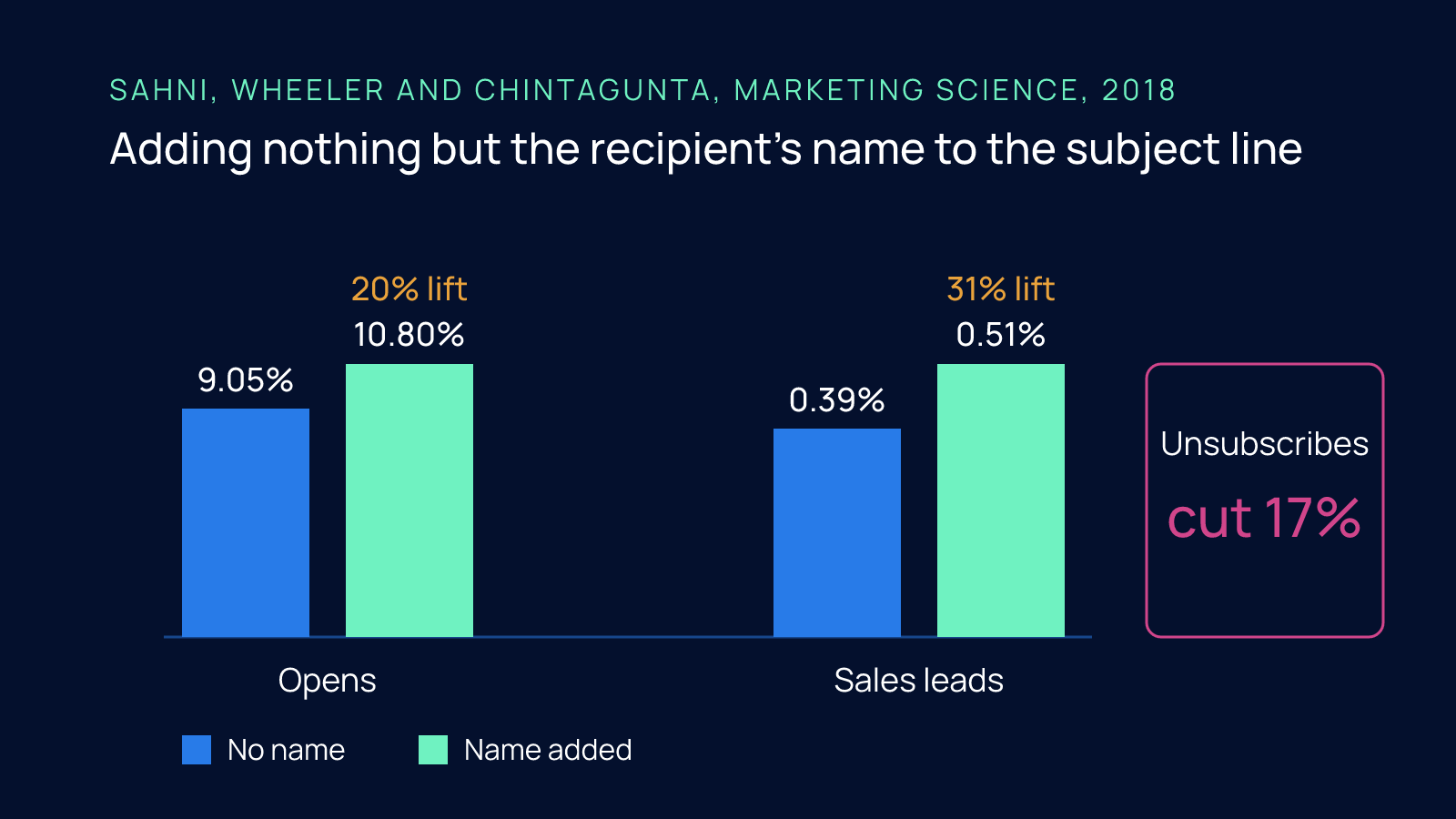
The research. Sahni, Wheeler and Chintagunta ran randomized field experiments across millions of email recipients (Marketing Science, 2018). The 20% at the top of this post is theirs. Adding nothing but the recipient's name to the subject line took opens from 9.05% to 10.80%, took sales leads from 0.39% to 0.51% (a 31% lift), and cut unsubscribes by 17%. A name is the smallest fragment of a person's own words you can possibly use. If the smallest fragment does that, treat it as the floor.
At Edge8. Our one-on-one preps draw on the person's own survey answers, their weekly check-ins and the transcript of their last conversation. 332 survey responses sit on people's records right now, and the prep quotes them back to the coach before the meeting starts. The coach walks in with the person's sentences, not a summary of them.
This week. Quote one thing the person actually said in your next message. Not a paraphrase. Their sentence, in quotation marks, followed by your response to it. If you cannot find a sentence, that tells you which row is empty.
3. Match the tone to the person, not the segment
Persuasive appeals that were matched to people's extraversion or openness-to-experience level resulted in up to 40% more clicks and up to 50% more purchases than their mismatching or un-personalized counterparts.
The research. Matz, Kosinski, Nave and Stillwell ran ads matched to individual personality traits (PNAS, 2017). Their finding: "Persuasive appeals that were matched to people's extraversion or openness-to-experience level resulted in up to 40% more clicks and up to 50% more purchases than their mismatching or un-personalized counterparts." Same product, same offer, different wording per person. A segment is a guess about a thousand people. A trait is a fact about one.
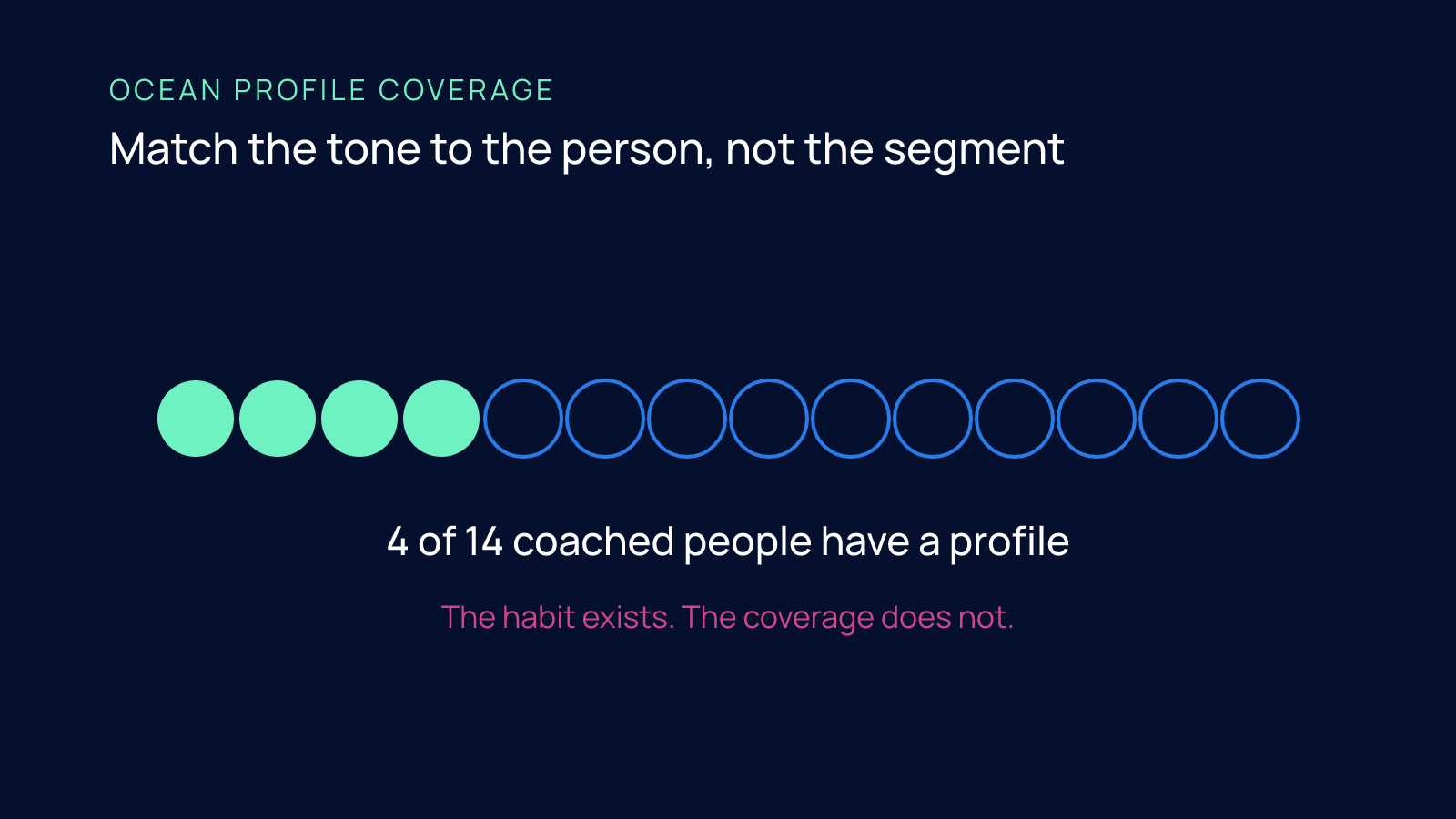
At Edge8. We use OCEAN profiles (the five-factor personality model: openness, conscientiousness, extraversion, agreeableness, neuroticism) to brief the coach before hard feedback, so the message lands the way that particular person receives it. Honest number: only 4 of 14 coached people have a profile yet. The habit exists. The coverage does not.
This week. Ask each direct report one question: how do you like to receive difficult news? Then write the answer down somewhere a system can read it, a field on their record, not a note in your head. You do not need a personality test to start. You need the person's own answer and a place to keep it.
4. Send it at their moment
The research. Page and Gehlbach studied a university's text-message assistant that sent individually tailored messages to admitted students over the summer (AERA Open, 2017). It cut summer melt, the share of admitted students who never showed up to enroll, by 21%. The students already had the information in a welcome packet. The difference was a message arriving at the moment the decision was live.
At Edge8. Broadcasts honor a send window in each recipient's time zone, not ours. The one-on-one cycle rolls forward on a fixed cadence so the prep is ready before anyone thinks about the meeting. The coach never has to remember to prepare, because the workflow remembers for them.
This week. Find the one moment each week your person is most likely to act, and send then. For a customer, that might be the morning they log in. For a direct report, the evening before your one-on-one, while there is still time to add to the agenda. One moment, written down, honored.
5. Make one ask, tied to what they already committed to
The research. No new study here, and none needed. Every experiment cited so far measured one behavior: a click, a purchase, an enrollment. None of them tested a message that asked for four things. And the strongest ask is not one you invent. It is one the person already made. You are not persuading anyone. You are reminding them of their own words, which is habit two applied to habit five.
At Edge8. 57 commitments logged across 30 one-on-ones, 29 of them still open. The next prep names the open ones specifically, so the coach opens with what the person said they would do, not with a fresh list.
This week. End every message with one thing. Make it the thing they said they would do. If your last three emails ended with a bulleted list of next steps, cut them to one each and watch what happens to the reply rate.
6. Let them co-author
The research. Rogelberg, writing in Harvard Business Review in November 2022, found that one-on-ones work best when the topics that matter to the direct report dominate the agenda, not the manager's, and that almost no organization trains managers to run them that way. The meeting that is supposed to be about the person is usually run by the other person.
At Edge8. Coach and team member both add and remove talking points before the meeting. The agenda belongs to both of them, and the record shows who added what. I wrote more about how we run this in better one-on-one meetings with AI.
This week. Before your next one-on-one, ask the person to add two items to the agenda before you add yours. Then keep your mouth shut until theirs are done. It is the cheapest personalization on this list and the one most managers skip.
7. Say the true thing, not the flattering thing
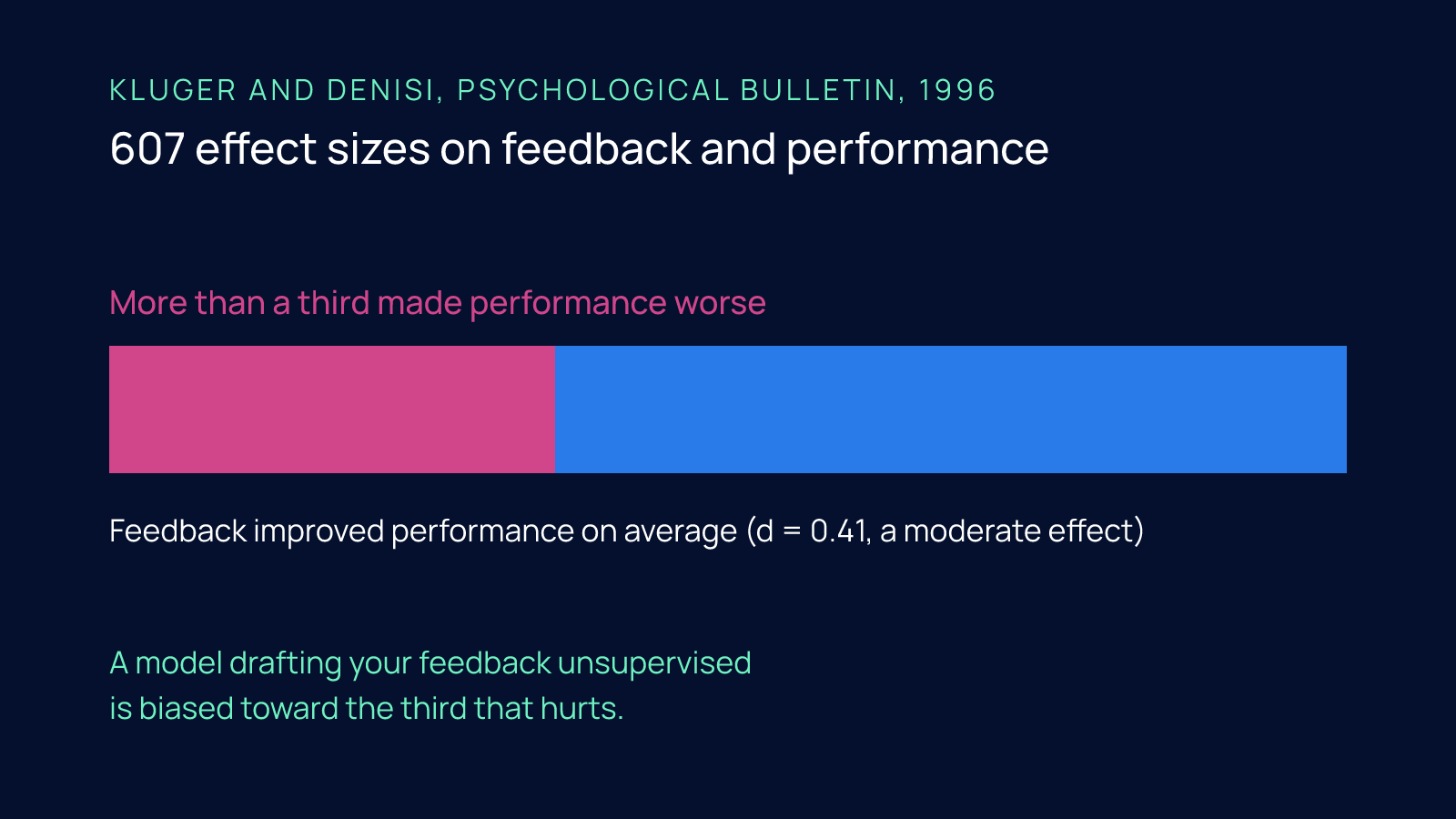
The research. Two sources, and together they should worry you. Kluger and DeNisi reviewed 607 effect sizes on feedback and performance (Psychological Bulletin, 1996). Feedback improved performance on average (d = 0.41, a moderate effect), but more than a third of feedback interventions made performance worse. Then Sharma and colleagues at Anthropic showed that leading AI assistants consistently tell people what they want to hear, and that people sometimes prefer the flattering answer to the correct one (arXiv, 2023). Put those together: a model drafting your feedback unsupervised is biased toward the third that hurts.
At Edge8. Recaps go to the team member only after the coach has reviewed them, precisely because a model left alone drifts toward praise. The review step is not bureaucracy. It is the difference between feedback and flattery wearing feedback's clothes.
This week. Read your next AI-drafted message and delete every compliment that is not tied to a fact. "Great work on the deck" goes. "The deck cut the pitch from twelve slides to six and the client signed" stays.
8. Close the loop and learn
The research. Again, no new study, because this habit is what makes research possible. Every source above ran a control and defined success before sending. Your version does not need a control group. It needs a sentence, written before you hit send, that says what "it worked" means for this message. Without it, you will judge the message by how it felt to write, which is the flattery problem from habit seven, turned on yourself.
At Edge8. Every link in the weekly letter is tagged so the next letter learns what got clicked and what did not. Trend reports per person refresh after each recap, and there are 5 so far. Small, but the loop is closed, and it will still be closed when there are 500.
This week. Decide what "it worked" means for one message before you send it. Reply within two days? Link clicked? Commitment closed? Write it down. Check it. That is the whole eighth habit, and it is the one that compounds the other seven.
The one way to get all eight wrong: collect it covertly
Aguirre, Mahr, Grewal, de Ruyter and Wetzels studied what they call the personalization paradox (Journal of Retailing, 2015). Personalization lifts click-through when people know their data was collected, and it lowers click-through when they discover the collection was covert. Same message, same data, opposite result, and the only variable was whether the person knew.
That means every habit above has a hidden precondition. The row is fine if the person knows it exists. Their words are fine if they know you kept them. The personality profile is fine if they have seen it. The moment you hide any of it, you flip from lift to drop, and you do it across all eight at once.
At Edge8, every survey is asked openly. Every OCEAN profile is published to the person it describes. Every recap is shared with the team member after the coach reviews it. Nobody is described in a record they cannot read.
Eight workflows, one builder
Read the list again and notice what is not on it: a vendor. Each of the eight is a workflow that runs on a row you already own. A name lookup. A quote pulled from a transcript. A field that says how someone takes hard news. A send window. An open-commitment check. A shared agenda. A review step before publish. A tag on a link. If you are in the AI Officer certification, you will recognize several of these as missions.
Which means the question is not what to buy. It is who builds these and keeps them running when the data changes. That person belongs on your team, owning the data layer and the workflows on top of it, not sitting at an agency sending you a report.
Here is the next step. Pick one of the eight. Run it on the next ten messages you send, whether those go to customers or to your own team. Write down what changed, even if the answer is nothing yet. Then reply to Edge8 with the number you picked, and we will talk about who should build the other seven.
The Automated Marketing and Sales CRM case study shows the marketing and sales system we are building these workflows on.
FAQ
How do I hyper-personalize messages to my customers and my team without buying new software?
Treat it as eight habits that run on one record per person you already own, not as a feature you purchase: start from one owned row, write from the person's own words, match tone to the individual, send at their moment, make one ask tied to a commitment they made, let them co-author the agenda, say the true thing rather than the flattering one, and define what worked before you send. The floor is low: in randomized field experiments across millions of recipients, adding only the recipient's name to a subject line took opens from 9.05% to 10.80%, a 20% lift (Sahni, Wheeler and Chintagunta, Marketing Science, 2018). Start this week by picking one real customer and counting how many systems hold a fact about them; if the answer is more than one, your first project is a merge, not a purchase.
How much does putting someone's name in the email subject line actually help?
More than most people expect for a single field, and it should be treated as the minimum, not the goal. In randomized field experiments with millions of email recipients, adding nothing but the recipient's name to the subject line took opens from 9.05% to 10.80% (a 20% lift), took sales leads from 0.39% to 0.51% (a 31% lift), and cut unsubscribes by 17% (Sahni, Wheeler and Chintagunta, Marketing Science, 2018). A name is the smallest fragment of a person's own words you can use, so if that alone moves the numbers, quoting a full sentence they actually said is the next step.
Does matching my message tone to someone's personality really increase response?
Yes, and the effect is large when the match is to the individual rather than a segment. Matz, Kosinski, Nave and Stillwell ran ads matched to individual personality traits and found that appeals matched to a person's extraversion or openness produced up to 40% more clicks and up to 50% more purchases than mismatched or unpersonalized versions (PNAS, 2017), with the same product and offer. You do not need a personality test to start: ask each direct report how they like to receive difficult news and store the answer in a field a system can read, because coverage is the hard part (in one small coached team, only 4 of 14 people have a profile so far).
Is it safe to let AI draft performance feedback for my team without reviewing it first?
No. Kluger and DeNisi reviewed 607 effect sizes on feedback and found it improved performance on average (d = 0.41, a moderate effect) but more than a third of feedback interventions made performance worse (Psychological Bulletin, 1996). Sharma and colleagues at Anthropic then showed that leading AI assistants consistently tell people what they want to hear and that people sometimes prefer the flattering answer to the correct one (arXiv, 2023). Put together, an unsupervised model drafting your feedback is biased toward the third that hurts, so add a review step and delete every compliment that is not tied to a specific fact.
What happens if I personalize messages using data people did not know I collected?
The lift reverses. Aguirre, Mahr, Grewal, de Ruyter and Wetzels found that personalization raises click-through when people know their data was collected and lowers it when they discover the collection was covert, with the same message and same data (Journal of Retailing, 2015). That precondition sits under every personalization habit, so the practical rule is that nobody should be described in a record they cannot read: the 332 survey responses in the example operation above were all asked openly, and every personality profile is published to the person it describes.