Why ChatGPT-5 Matters in an Age of Incremental AI Progress
Source: https://www.edge8.ai/post/why-chat-gpt-5-matters-in-age-of-incremental-ai-progress Categories: AI in Business | AI Models | Strategy
A curious thing happened when ChatGPT-5 was released. For the first time, OpenAI's newest model wasn't universally hailed as the undisputed champion of AI capabilities. The All-In podcast even went so far as to label it a "flop." But was it really? And what does this tell us about where we are in the AI evolution cycle?

The New Normal of AI Releases
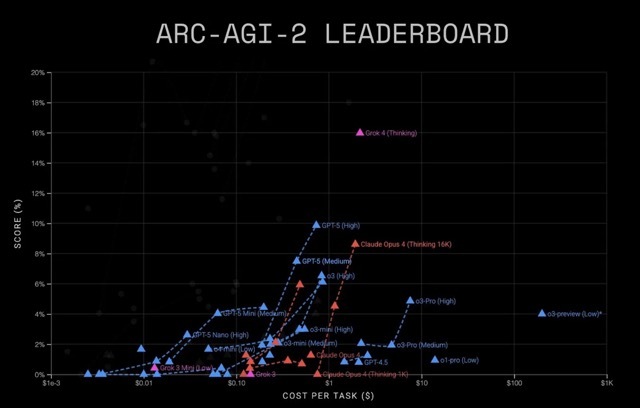
The metrics tell a compelling story that challenges our assumptions about AI progress. On benchmarks like Humanity's Last Exam, a collection of 2,500 extremely difficult questions that even humans struggle with, ChatGPT-5 wasn't the clear winner. Grok 4 edged it out slightly and performed significantly better on the ARC AGI Index, which measures AI performance on simple tasks that humans find intuitive but machines traditionally struggle with.
This represents a fascinating shift in the industry. We've entered an era where progress in foundational AI capabilities may be becoming more incremental rather than revolutionary with each release. ChatGPT-5 is absolutely impressive, but our expectations have been conditioned by the dramatic leaps we've seen in previous generations.
The implications for business strategy are profound. Leaders can no longer assume that the newest model will automatically deliver the most value for their organization.
When User Experience Trumps Technical Supremacy
David Friedberg made an astute observation about these releases: for average users, being the "best" versus "almost the best" on technical benchmarks makes virtually no practical difference. What matters more is the user experience, and here ChatGPT-5 delivered meaningful innovation.
The elimination of model selection is genuinely transformative for mainstream adoption. Users no longer need to understand the difference between reasoning models, hybrid approaches, or multimodal capabilities. Other leading systems are moving in this direction as well, simplifying the interface while maintaining powerful capabilities underneath.
This shift from technical one-upmanship to user-centric design represents a maturing of the AI industry. It's reminiscent of the evolution we saw in smartphone development: after the initial hardware revolutions, the most meaningful improvements came through software and user experience refinements.
What This Means for Business Leaders
The incremental progress era creates both challenges and opportunities for organizations building AI strategies:
The challenge: Competitive differentiation through AI model selection is diminishing. If all leading models perform similarly on most business tasks, the advantage shifts to how you use AI, not which AI you use.
The opportunity: Organizations that have built robust AI workflows, training data, and institutional knowledge now have more durable competitive advantages. The edge is in your data, your processes, and your people, not just your model choice.
Key strategic implications:
- Stop chasing the newest model for its own sake; evaluate based on specific use case performance
- Invest in prompt engineering and workflow design, these skills compound in value as models plateau
- Build proprietary training data, your unique data becomes more valuable as foundation models converge
- Focus on integration depth, how well AI is woven into your operations matters more than which AI you've chosen
The Real Innovation in ChatGPT-5
Beyond the benchmark debate, ChatGPT-5 represents meaningful progress in how AI understands and maintains context across long conversations. For business users running complex, multi-step workflows, this contextual coherence creates genuine value that benchmarks don't capture.
The interface simplification signals that AI providers are shifting their competitive focus from technical capability to accessibility and adoption. This democratization trend will accelerate AI's business impact by reducing the expertise barrier for effective use.
For business leaders, the message is clear: the era of waiting for the next breakthrough model is over. The organizations winning with AI today are those that have mastered the models available now, and that mastery will compound regardless of which incremental improvement arrives next.